Abdul Rehman Shakir: Bringing the Siege of Rome to Life with Generative AI

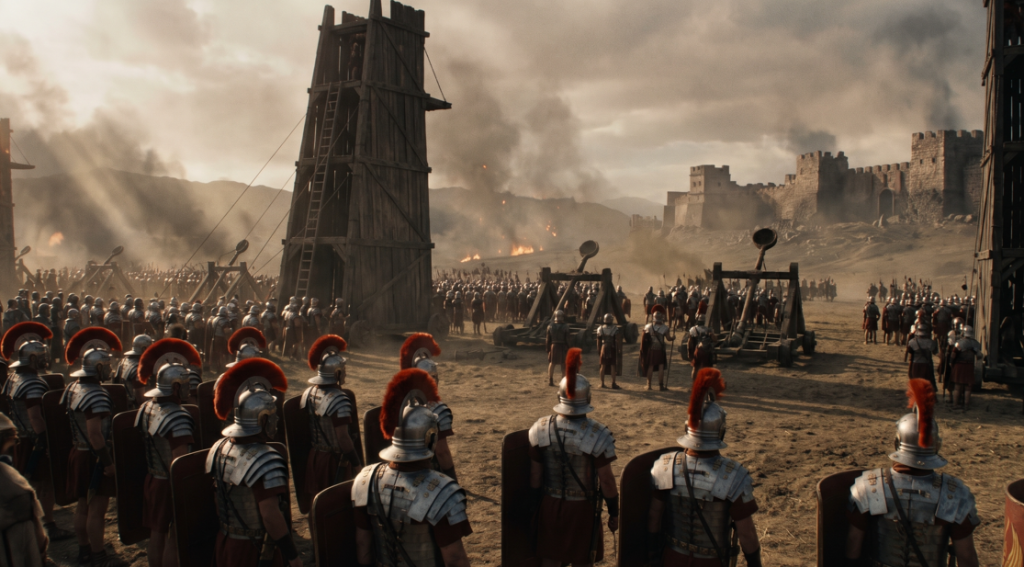
Recreating the colossal scale of historical warfare has always been a major obstacle for independent filmmakers and students. To depict an event like a Roman siege, traditional cinema demands thousands of extras, complex stunt coordination, and expensive practical effects. For our group project ‘Reminisco’, we are exploring how generative AI can recreate these massive, chaotic historical moments on a student budget, specifically focusing on a 1st-century Roman siege scenario.
The primary advantage of generative AI in this context is its ability to simulate massive crowds and complex battlefields from natural language prompts. Instead of trying to coordinate hundreds of actors, we can guide AI models to generate vast legions of Roman soldiers in authentic armor (Lorica Segmentata) and red-crested helmets, maneuvering alongside massive siege engines like catapults and towers. By feeding historical references into generative video and image models, we can iterate on large-scale battle formations, environmental destruction, and atmospheric effects like rising smoke and dusty late-afternoon sunlight. This allows us to capture the cinematic epic feel of a siege without needing a Hollywood-scale production.
However, bringing ancient history to life using AI is not without its hurdles. One of the biggest challenges is maintaining historical and physical accuracy in dense crowd scenes. Generative models often struggle with fine details in large groups, leading to visual glitches like soldiers merging into the environment, holding incorrect weapons, or moving unnaturally. Furthermore, AI lacks an inherent understanding of historical tactics; it will happily generate anachronistic gear or impossible military formations if not tightly constrained.
To counter this, our workflow involves a lot of historical research. We must provide highly specific prompts detailing the exact equipment, siege towers, and formations based on historical records. We then generate shorter, focused sequences that can be carefully edited, stitched together, and paired with realistic, immersive sound design like clashing steel, distant shouting, and burning timber. By combining meticulous historical research with AI generative capabilities, we are able to transform static historical text into dynamic, cinematic narratives.