Badar Amin: Reliving the Mughal Empire’s Grand Court via AI-Driven Cinema

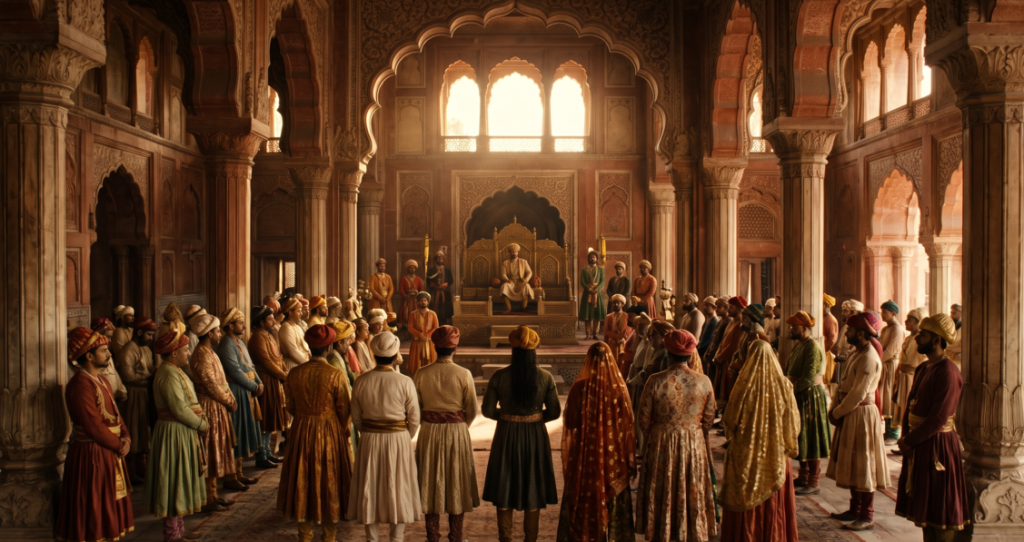
The majestic grandeur of South Asia’s history is frequently celebrated in textbooks, yet its vibrant courtly life is rarely seen in immersive visual formats due to the immense cost of period-accurate filmmaking. Reconstructing a 17th-century Mughal Empire’s grand imperial court—such as the iconic Lahore Fort—requires incredibly ornate sets, thousands of hand-crafted period costumes, and intricate cultural styling. For our group project ‘Reminisco’, we decided to explore how generative AI can democratize historical filmmaking, allowing students to recreate the opulent atmosphere of the Mughal court on a humble laptop.
Our workflow relies on prompting AI to understand and render the specific architectural and cultural nuances of the Mughal era. We focus heavily on generating the intricate red sandstone and marble pillars, ornate hand-carved arches, and the distinctive golden, dust-mote-filled natural lighting of a Diwan-i-Am (Hall of Public Audience). AI allows us to simulate an immersive, bustling Royal court packed with noblemen, guards, and attendees without the impossible logistics of sourcing hundreds of extras. By describing the specific historical garments—flowing jamas, turbans, sherwanis, and richly patterned fabrics—we can quickly generate cinematic scenes that evoke the opulent scale of 17th-century Lahore.
Despite its vast potential, capturing historical authenticity through AI is incredibly challenging. Generative models often apply generalized orientalist styles or modern fantasy tropes instead of accurate historical aesthetics. They frequently struggle with the complex symmetry of Mughal architecture, occasionally warping arches or adding inappropriate ornamental patterns.
Moreover, to keep the scene grounded, the generative outputs must be paired with careful, manually curated soundscapes: the murmur of a crowded court, rustling textiles, and traditional instrumentation like the sitar and tabla. By providing historically informed prompts and filtering the visual generation through strict research, we strive to avoid digital anachronisms. Ultimately, ‘Reminisco’ shows that AI can serve as a powerful historical reconstructive tool, helping us remember and visually celebrate our rich heritage.